


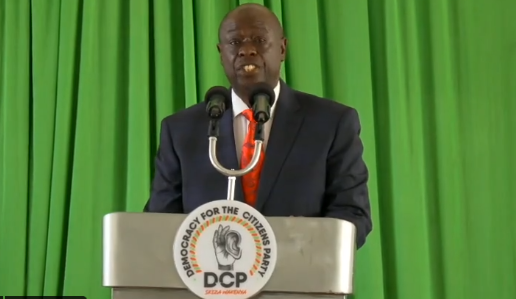
Former Deputy President Rigathi Gachagua has raised fresh concerns over the integrity of the 2027 General Election, alleging a conspiracy within the Independent Electoral and Boundaries Commission (IEBC) to award a critical election technology tender to a South Korean company he described as disreputable.
Gachagua made the allegations on Monday, August 24, 2026, as he concluded his 56-day political consultations at his Wamunyoro residence in Nyeri.
The Democracy for Citizens Party (DCP) leader alleged that some IEBC officials were pushing for the procurement of an election results transmission system from a South Korean firm, which he identified as Miru System Company Limited.
“We know they want to do some monkey business. There is a game being played there by the vice chair, who was an official of ODM; she is very close to Hassan Joho,” Gachagua alleged.
He claimed the IEBC vice chairperson, the commission’s chairperson Erastus Ethekon and Mining and Blue Economy Cabinet Secretary Hassan Joho had links to the company.
“She, the chairman, and Joho have come up with a company called Miru System Company Limited from Korea. They made specs for this tender, tailor-made for this company,” he said.
Gachagua further alleged that the company had a poor record in previous elections where it had participated.
“In all the elections it has participated in, there was failure. We cannot accept this company; it is being pushed by the vice chair of IEBC together with Ethekon,” he said.
He also claimed the government had bought a house in Karen for Ethekon, suggesting that the alleged arrangement was part of a wider attempt to influence the electoral commission.
The allegations come as IEBC continues preparations for the August 2027 General Election, including procurement of technology and other systems that will be used in managing the polls and transmitting results.
Gachagua warned that Kenyans should closely monitor the commission’s procurement processes, arguing that the credibility of the election would depend not only on voting but also on the systems used to transmit and manage results.
He said he would continue investigating the information available to him before making further disclosures.
Gachagua also revisited his fallout with President William Ruto, linking the deterioration of their relationship to the government’s response to the 2024 Gen Z protests.
He claimed his differences with Ruto became irreconcilable after he opposed what he described as instructions to use extreme measures against young protesters.
“When the issue of young people came and he gave instructions that they should be abducted, tortured and, if possible, killed. I said no. I said it is against the 10 commandments: thou shalt not kill,” Gachagua said.
The former Deputy President said he travelled to Mombasa following Ruto’s June 25, 2024 address in which the President condemned the protests.
“I took a plane and went to Mombasa… The following day, I called for a press conference; I said I did not agree with the decision,” he said.
Gachagua claimed Ruto later called him, abused him and warned him that he would face consequences.
He challenged Gen Z to move beyond criticism of the government on social media and take part in the electoral process ahead of the 2027 polls.
“Criticizing William Ruto on smartphones is not enough, shouting one term is not enough… You must go the extra mile,” he said.
“We do not want to remove Ruto through unconstitutional means; we want him to be around; we want to defeat him at the ballot. People must register as voters and come out and vote.”
Gachagua also launched a fresh attack on Deputy President Kithure Kindiki, accusing him of following Ruto’s instructions during the Gen Z protests.
He recalled a telephone conversation he claimed to have had with Kindiki over the government’s response to the demonstrations.
“I called Kindiki; that is why I have very little regard for that man. I said, what you are being told to do, is it right? Is it biblical, is it in accordance with the Constitution?” Gachagua said.
According to Gachagua, Kindiki responded: “Mimi ni lazima nifanye vile rais amesema.”
Gachagua said he then asked Kindiki whether that included abducting and killing young people.
“Akisema sasa kama rais amesema, mimi nitafanya nini? If he refused and I refused, the two of us, probably those boys and girls, would not have died,” he claimed.
Gachagua has previously accused Kindiki of allowing himself to be used by Ruto to divide the Mt Kenya region, deepening the political rivalry between the two leaders.
Gachagua maintained that he would not enter into a political deal with Ruto ahead of the 2027 elections.
“I cannot take his money. He cannot bribe me. He cannot intimidate me,” he said.
He reiterated his commitment to ensuring that Ruto serves only one term and urged Kenyans opposed to the administration to focus on defeating the President at the ballot.
The conclusion of the Wamunyoro consultations marks a new phase in Gachagua’s political mobilisation.
He is scheduled to travel to the United States on Wednesday with his wife, Pastor Dorcas Gachagua, for what he has described as a period of solitude and consultations with Kenyans in the diaspora.
His latest claims on IEBC, coupled with his renewed attacks on Ruto and Kindiki, are likely to intensify the political debate over the credibility of the 2027 election and the battle for Kenya’s next government.

