The Great Rift Valley does not offer sympathy. Spread across 333 kilometres of bone-dry gravel, jagged volcanic rock, treacherous fesh-fesh sand and rain-softened mud, the 2026 Safari Rally Kenya was, by every measure, the most demanding event on the World Rally Championship calendar.
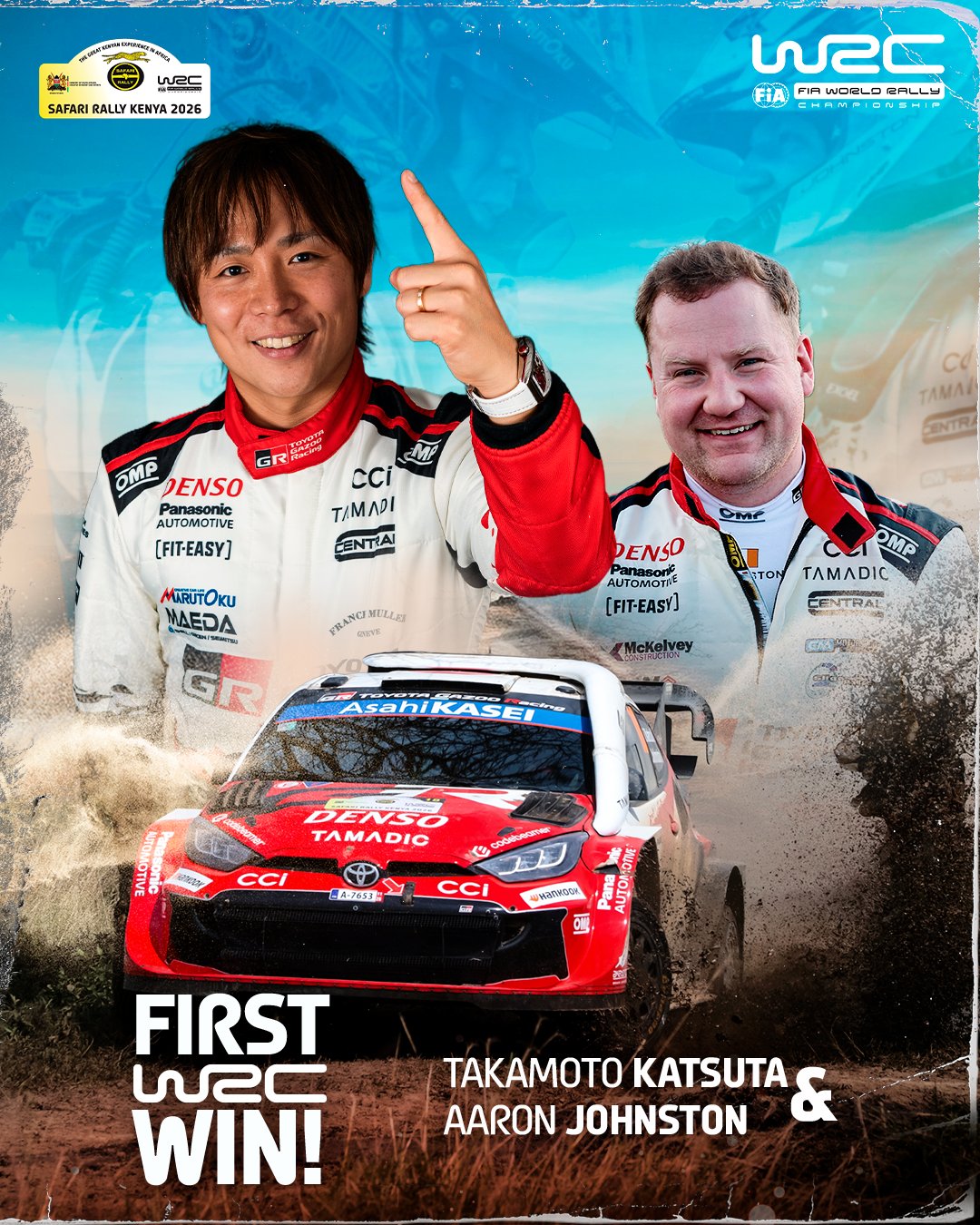
And on Sunday, March 15, when the dust finally cleared at the Hell’s Gate Power Stage in Naivasha, only one name stood atop the timing sheets: Takamoto Katsuta.
The 30-year-old Japanese driver and co-driver Aaron Johnston crossed the finish line in a total time of 3 hours, 16 minutes and 5.6 seconds, 27.4 seconds clear of Adrien Fourmaux of Hyundai, who claimed the runner-up spot and handed the Korean manufacturer its first podium of the 2026 season.
Young Toyota charger Sami Pajari completed the podium in third place, a further four minutes and 26 seconds in arrears, his result made all the more remarkable after he lost over five minutes following a tyre explosion and second puncture on Saturday morning.
President William Ruto was present at the finish ceremony at Naivasha to personally present Katsuta with the winner’s trophy, a carved wooden artefact that has become synonymous with this most Kenyan of occasions.
For Katsuta, who has contested the WRC Safari Rally multiple times without ever standing at its summit, the moment was both a personal breakthrough and a career-defining milestone.
The rally began under a cloud of uncertainty. Heavy rainfall in the days preceding the event had transformed several stages into near-impassable mud baths, while the Nawisa shakedown, a brand new 6.31km test introduced to the 2026 calendar, offered an early and unforgiving preview of what was to come.
Belgian champion Thierry Neuville topped the shakedown times, but it was Toyota’s Oliver Solberg who would emerge as the dominant force across the first competitive day.
The Norwegian, making only his fourth start for Toyota Gazoo Racing WRT, seized the rally lead by a slender 1.0 second margin at the end of Friday’s stages.
Solberg’s driving over Kenya’s rutted tracks and mud-slicked mountain passes was a revelation,controlled, precise and seemingly untroubled by the surface changes that unsettled several rivals.
Behind him, Toyota occupied three of the top four positions, with championship leader Elfyn Evans and Katsuta also prominently placed.
Katsuta, notably, had not been among the pre-event favourites. He finished seventh in the shakedown, and several pundits had pointed to Evans, defending Safari Rally champion, or Ogier, the only active driver with multiple wins in Kenya, as the most likely victors. The weekend, it seemed, was already being written around other names.
What transpired on Saturday afternoon was the kind of dramatic cascade of misfortune that makes the Safari Rally unique in world motorsport.
In the space of little more than thirty minutes, the championship landscape was shattered beyond recognition.
First to fall was Elfyn Evans. The Welshman, who had entered the rally as the WRC Drivers’ Championship leader and the defending Kenya winner, retired from competition mid-stage after his Toyota GR Yaris developed terminal rear-right suspension damage.
For Evans, who had been running solidly at the front of the field, it was a devastating blow to both his rally and his championship ambitions. The Safari had claimed its most prominent scalp.
Minutes later, disaster struck twice more in quick succession on the liaison road back to the Naivasha service park.
Oliver Solberg, who had led the rally from Friday and seemed destined for his first WRC victory, suffered a catastrophic clutch failure that brought his GR Yaris to a halt.
He would eventually be classified tenth, more than sixteen minutes behind Katsuta.
Then, just as the shock of Solberg’s retirement was still rippling through the paddock, nine-time world champion Sébastien Ogier’s challenge ended with an alternator malfunction, an electrical failure that silenced the most experienced African campaigner in the field.
The simultaneous elimination of three championship-calibre drivers in a single afternoon was without recent precedent in WRC competition.
In their wake, Katsuta stood alone at the front, holding a commanding 1 minute and 25.5 second advantage over the field entering Sunday’s final day.
Entering Sunday’s final leg with a lead of one minute and 25.5 seconds, Katsuta faced a choice familiar to every rally driver who has held the Safari lead overnight: push and risk mechanical failure, or manage the pace and bring the car home. He chose the latter, and executed it to perfection.
Across two passes through the 11.32-mile Oserengoni stage and the iconic 6.51-mile Hell’s Gate circuit, Katsuta drove with the composure of a veteran and the precision of a craftsman. He did not win a single stage on Sunday. He did not need to.
His 27.4-second victory margin over Fourmaux reflected not a dominant final-day drive but a masterclass in competitive restraint, the art of knowing when the race is already won.
Fourmaux, driving the Hyundai i20 N Rally1, gave his manufacturer genuine cause for optimism.
Despite battling overheating issues throughout the weekend, the Frenchman pushed consistently to the finish and earned Hyundai their first podium of the 2026 campaign.
Behind him, Pajari’s third place was perhaps the most extraordinary result of the weekend: the young Finnish driver lost more than five minutes to a tyre explosion on Saturday and still finished on the podium through sheer determination and a fortunate turn in the retirements ahead of him.
Esapekka Lappi took fourth overall in the second Hyundai, claiming his first points finish at the Safari Rally.
It was a quiet, careful performance,described by his own team as a strategy of ‘survival first’, but effective in a rally where simply finishing represents an achievement.
No event in the World Rally Championship produces results like the Safari. It is the only rally that can simultaneously eliminate the championship leader, the overnight rally leader and the defending nine-time world champion in a single afternoon and do so not through driver error, but through the sheer destructive power of the terrain.
Saturday’s triple retirement was not exceptional by Safari standards. It was, in many ways, an entirely typical afternoon in Naivasha.
For Elfyn Evans, the result is deeply damaging to his championship aspirations. The Welshman entered Kenya leading the drivers’ standings; he left it having scored zero points from a rally he won just twelve months ago.
He now sits one point behind Katsuta in the championship, with the season only three rounds old and eleven remaining. The mathematics are not irreparable, but the psychological blow of surrendering a lead in the manner he did, to a mechanical failure rather than a competitor, adds a layer of frustration that no amount of analysis can fully resolve.
Katsuta, by contrast, arrives as a legitimate title contender for the first time in his WRC career. His performance in Kenya, fourth in shakedown, unheralded through Friday, survivor of Saturday’s carnage, composed finisher on Sunday, is the story of a driver whose time has finally come.
It is worth noting that Katsuta did not manufacture his victory through risk or aggression. He was simply still standing when others were not. In rallying, that is often enough.
In the WRC2 category, Estonia’s Robert Virves claimed a commanding victory on his debut appearance at the Safari Rally, finishing 30.3 seconds ahead of Gus Greensmith. Paraguay’s Fabrizio Zaldivar completed the WRC2 podium in third, ahead of former WRC front-runner Andreas Mikkelsen in fourth.
The 2026 Safari Rally was, in one sense, a Toyota clean sweep, first and third from GR Yaris machinery, with Hyundai’s Fourmaux sandwiched between them.
In another sense, it was a weekend that underlined the double-edged nature of Toyota’s dominance: their cars occupied the top four championship positions entering Kenya, and the terrain claimed three of the four, leaving only Katsuta standing.
For the manufacturers’ championship, Toyota extends their lead to 157 points against Hyundai’s 114, with M-Sport Ford on 23 in third.
The Japanese manufacturer’s grip on the WRC landscape remains firm. Whether that strength translates to sustained individual success across the remaining eleven rounds remains the championship’s defining question.
When Katsuta drove his Toyota GR Yaris Rally1 across the finish ramp at Hell’s Gate and heard his race time confirmed over the team radio, the significance of the moment was not lost on those gathered at the Naivasha ceremonial finish. A Japanese driver had won the Safari Rally Kenya for the first time.
President Ruto pressed the trophy into Katsuta’s hands with the warmth of a host nation that has embraced the WRC as its own.
Aaron Johnston, the Irish co-driver whose composure and technical precision had guided Katsuta through four days of extreme conditions, embraced his driver with visible relief and joy.
“The team always believed in me when I was failing all the time,” Katsuta told reporters afterward. “I’m here because of them and Aaron.”
It is a sentiment that captures the collaborative nature of rally sport but does not fully account for what Katsuta himself provided: steadiness, mechanical sympathy and the resolve to see a brutal rally through to its end.
The 2026 WRC season now travels to Rijeka, Croatia on April 9–12 for the next round. Evans will arrive needing to respond.
Katsuta will arrive as a Safari Rally champion for the first time, and, for the first time in his career, as a genuine contender for the world title.
In Naivasha, in March, on red volcanic dust, something shifted in the WRC’s balance of power. Whether it lasts the season is a question the remaining eleven rounds will answer.