


Kenya and the United States have renewed efforts to advance their $2.5 billion health partnership despite court challenges and concerns over sensitive patient data.
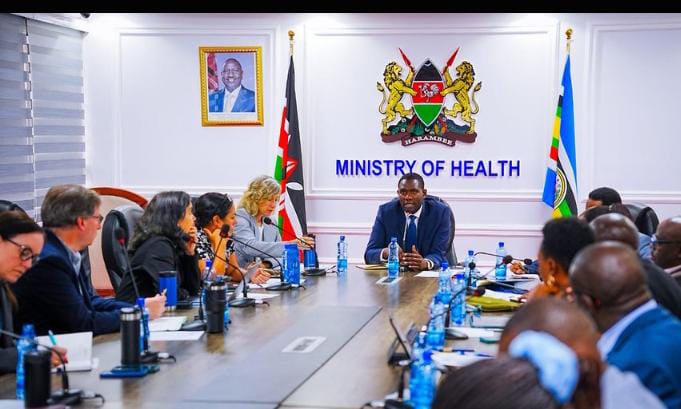
Principal Secretary for Medical Services Dr Ouma Oluga chaired the sixth Joint Health Cooperation Framework Steering Committee meeting, bringing together senior officials from Kenya and the United States to assess progress in implementing the agreement.
The meeting was attended by US Deputy Chief of Mission Carla Bernini, Head of the Project Management Unit Dr Mohammed Abdi Sheikh and representatives of the Council of Governors, National Treasury and technical partners.
Discussions centred on the transition of US-supported health programmes to greater Kenyan government leadership, with officials reviewing financing arrangements, implementation timelines and measures to minimise risks during the transition.
The programmes covered under the framework include HIV, tuberculosis, malaria, maternal and child health, and preparedness and response to disease outbreaks.
Officials said the objective is to ensure that the programmes remain sustainable as Kenya gradually assumes greater responsibility for financing and managing services previously heavily supported by the United States.
The Kenya-US Health Cooperation Framework was signed in December 2025 under the America First Global Health Strategy.
Under the five-year arrangement, the United States plans to provide up to $1.6 billion in health assistance, while Kenya has committed to increasing domestic health spending by about $850 million as American support declines.
The government has described the agreement as a shift from traditional donor-driven programmes towards a government-to-government model in which Kenya takes greater ownership of its health priorities.
Oluga, who led Kenya’s negotiating team, has strongly defended the agreement, describing it as a major departure from previous arrangements.
“This cooperation framework is quite a departure from the past and will have a lasting impact on health for all,” Oluga said during the signing of the agreement.
“I can confirm we promoted the best interests of our people ensuring critical service certainty as well as alignment with Kenya government agenda in spirit and letter of every paragraph,” he added.
Oluga later described the agreement as the best health deal Kenya had negotiated, saying he had placed his professional reputation behind it.
However, implementation of the framework has faced legal and public scrutiny since it was signed.
The High Court temporarily halted implementation in December 2025 following petitions challenging aspects of the agreement, particularly provisions concerning the sharing and protection of health data.
The petitioners, including Busia Senator Okiya Omtatah and civil society organisations, raised concerns that sensitive information involving Kenyans living with HIV, tuberculosis patients and other healthcare users could be exposed through data-sharing arrangements.
They also argued that the agreement had been entered into without adequate public participation and parliamentary approval.
The Court of Appeal subsequently stayed the High Court’s suspension, allowing preparations for implementation of the framework to continue.
The deal has also generated concerns among county governments, which play a central role in delivering healthcare services under Kenya’s devolved system.
Counties have argued that they need to be adequately involved in the transition because they are responsible for most frontline health services.
At Thursday’s meeting, officials appeared focused on addressing those concerns while keeping the partnership on course.
The discussions included county consultations, co-financing arrangements and transition timelines intended to prevent disruption of essential services as US funding gradually reduces.
Bernini and Kenyan officials also presented the partnership as mutually beneficial, arguing that stronger health systems in Kenya would improve disease surveillance and outbreak preparedness, with benefits extending beyond the country’s borders.
The government maintains that greater domestic financing and leadership will ultimately strengthen Kenya’s health system and reduce dependence on external donors.
But questions over the agreement’s legality, data protection, county participation and Kenya’s ability to meet its increased financial commitments remain unresolved.

