


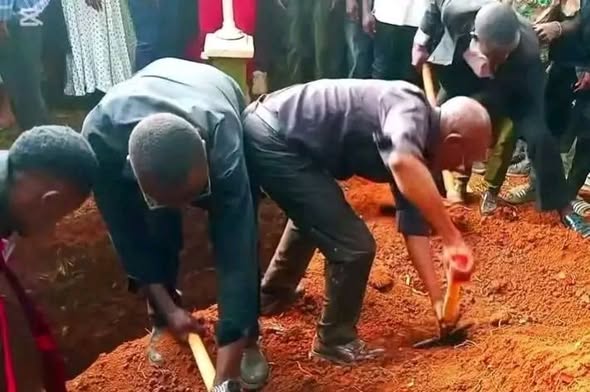
The final handfuls of soil placed on a grave can carry a lifetime of meaning, and for the Luhya, burial is deeply rooted in family, duty and belonging.
When Kakamega Senator and medical doctor Boni Khalwale stepped forward with his sons to personally heap soil onto the grave of his late wife, Gloria Sekeiyan Khalwale, at their Malinya home in Ikolomani on August 21, 2026, the act was more than a farewell.
It was a deeply symbolic moment rooted in Luhya, or Mulembe, traditions surrounding death, family and the relationship between the deceased and the homestead.
In many Luhya communities, burial is not simply the physical act of laying a loved one to rest.
It is a cultural process through which the family acknowledges death, honours the deceased and symbolically returns them to the soil of their ancestral home.
The final heaping of soil is particularly significant.
Traditionally, the husband and sons may take the first spades of soil, marking their responsibility for the burial and demonstrating their continuing bond with the deceased.
For a husband, the act can represent a final expression of responsibility and love towards his wife.
For sons, it signifies their role as custodians of the family and its lineage.
Khalwale’s decision to participate personally in the ritual therefore carried a meaning beyond the public image of a politician mourning his wife.
Dressed in black and standing alongside his sons, he physically took part in the final stage of committing Gloria to the earth at the family homestead.
The gesture also reflects the importance attached to the homestead in Luhya culture.
Traditionally, the positioning of graves within a homestead follows cultural practices, including considerations about where women and men are buried.
A wife’s grave is traditionally placed on a particular side of the house, reflecting the organisation and symbolism of the family compound.
Such practices vary among the different Luhya sub-groups and clans, meaning there is no single burial custom followed by every Luhya family.
However, the underlying principle remains significant: burial connects the deceased to the family, the homestead and the community from which they came.
The soil itself therefore assumes symbolic importance.
By taking soil and placing it over Gloria’s grave, Khalwale and his sons were participating in a rite that physically completes the burial while symbolically closing the circle between the deceased, the family and the land.
For the family, it was also a public declaration that Gloria belonged to the homestead and would remain part of its history even after death.
The ceremony at Malinya offered a glimpse into how traditional practices continue to coexist with modern public life.
Khalwale is known nationally as a politician and doctor, but at the graveside, the public titles gave way to the role of husband and father.
His participation underscored a central feature of traditional African funerals: grief is not only expressed through words, prayers and speeches, but also through rituals that assign responsibilities to surviving family members.
For the Luhya, the final act of covering a grave can consequently carry a powerful message.
It says goodbye, but it also affirms belonging, responsibility and continuity.
At Gloria’s graveside, Khalwale’s spade was therefore not merely moving soil.
It was part of a centuries-old cultural language through which a family said farewell while returning one of its own to the earth of home.

