


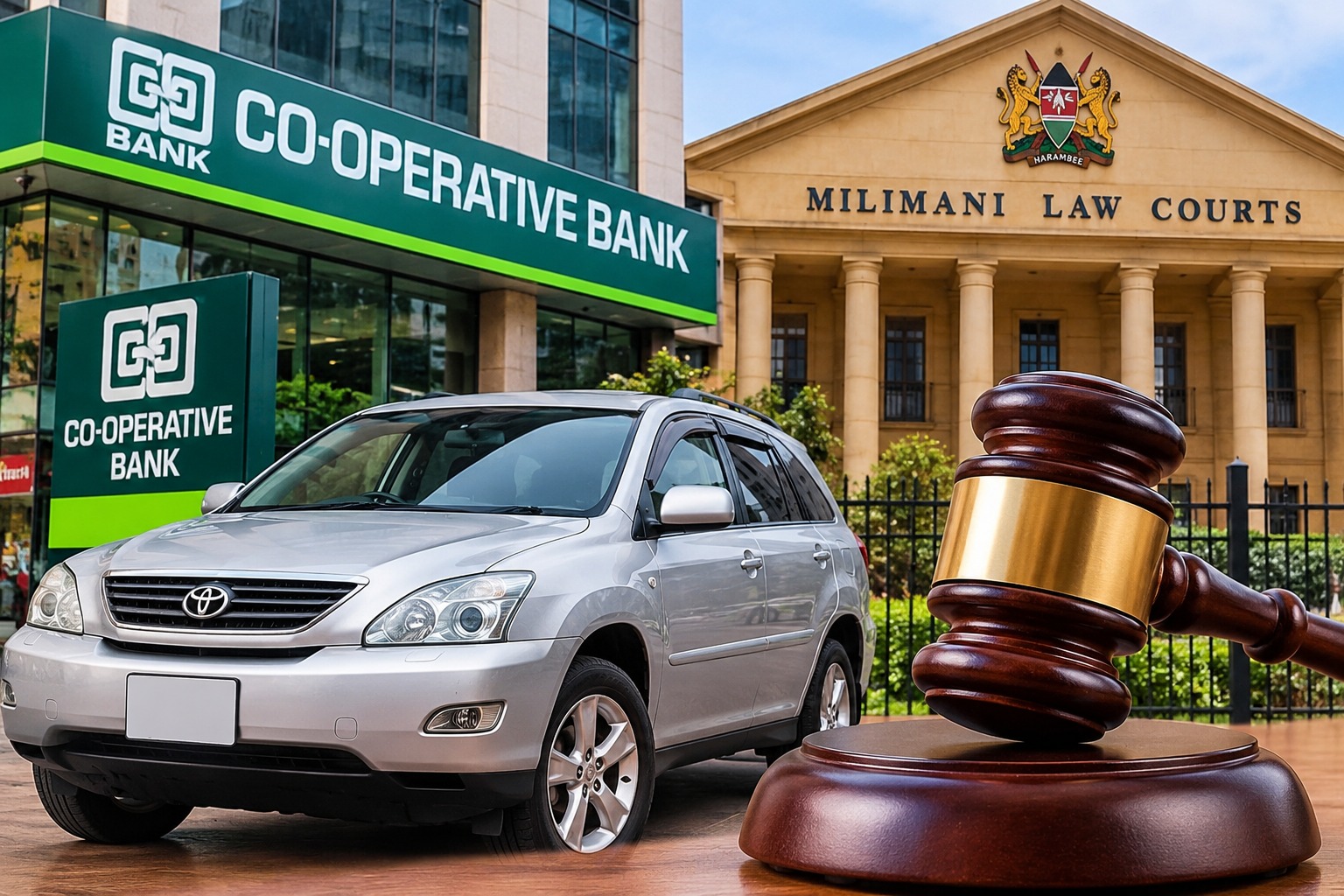
Cooperative Bank of Kenya has suffered a major legal setback after the Court of Appeal upheld a judgment declaring its repossession and sale of a customer’s vehicle unlawful.
The three-judge appellate bench dismissed the bank’s appeal against Peter Musya Kiteme, ruling that it violated consumer protection laws by repossessing and selling his Toyota Harrier without obtaining the necessary court approval.
In a judgment delivered on September 25, 2026, Justices A.K. Murgor, K.I. Laibuta and G.W. Ngenye-Macharia upheld findings that Kiteme had paid more than two-thirds of the financed amount, meaning the bank could not repossess or dispose of the vehicle without leave of the High Court.
The dispute arose from an asset finance hire purchase agreement entered into on April 24, 2018, under which the bank financed Sh2.232 million towards the purchase of the Toyota Harrier.
The vehicle had a purchase price of Sh2.95 million, with Kiteme contributing Sh718,000 directly to the dealer.
However, the bank repossessed the vehicle on May 27, 2021, claiming outstanding arrears of Sh455,029.
Kiteme maintained that he subsequently cleared the arrears, auctioneer’s fees and storage charges by June 15, 2021, but the bank declined to release his vehicle.
Instead, the financial institution proceeded to sell the Toyota Harrier to George Njuguna Kamau on September 22, 2021, for Sh1.52 million, without conducting a valuation.
The customer challenged the repossession and sale, arguing that he had already paid more than 85 per cent of the financed amount and that the bank had violated Section 20 of the Consumer Protection Act.
The Court of Appeal agreed, observing that the law protects consumers who have paid at least two-thirds of their obligations under future performance agreements.
The judges stated that Section 20 of the Consumer Protection Act provides that any contractual provision allowing a supplier to repossess or resell goods after a consumer has paid two-thirds or more of the payment obligation is unenforceable without leave of the High Court.
“Accordingly, it follows that, once the statutory threshold was attained, the Appellant bank could not lawfully repossess, seize, or dispose of the goods without first obtaining leave of the High Court,” the judges ruled.
The bank had also argued that it was entitled to consolidate Kiteme’s two hire purchase facilities and recover the vehicle over obligations arising from the separate financing arrangement.
However, the appellate court rejected this argument, noting that the two agreements were separate and distinct and did not expressly provide for consolidation.
The judges observed that although banks generally enjoy the right to combine customer accounts, that power is not absolute.
“The banker’s right to combine accounts is not absolute,” the court stated.
The court further found that the bank had failed to demonstrate any lawful or contractual basis for consolidating the accounts or repossessing the vehicle over obligations arising from another facility.
On compensation, the judges upheld the award of Sh1,777,541.28, subject to deductions specified in the lower court’s judgment, alongside Sh300,000 in exemplary damages.
They noted that the bank had failed to obtain court approval, conduct a valuation before the sale and release the vehicle after the arrears were cleared.
“Given the clear breaches of the law, we cannot fault the courts below for concluding that such conduct warranted an award of exemplary damages,” the judges stated.
The court consequently found no reason to interfere with the lower courts’ awards of interest and costs.
“In sum, there is no merit in the appeal which we hereby dismiss with costs to the Respondent,” the judges ruled.
The decision was delivered at Mombasa.

