


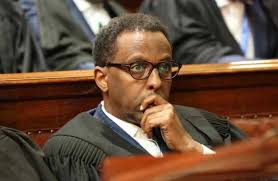
Senior Counsel Ahmednasir Abdullahi has expressed deep remorse and pledged to reform his conduct, as he seeks to have the Supreme Court lift a two-year ban that has barred him from appearing before Kenya’s apex court.
Through his representatives, Senior Counsels Paul Muite and Fred Ngatia, Ahmednasir conveyed his contrition and commitment to respecting judicial dignity during an application heard on Tuesday before Chief Justice Martha Koome and five other Supreme Court judges.
In a dramatic turnaround from his previously defiant position, Ahmednasir has acknowledged the seriousness of his past conduct and expressed genuine regret.
Lawyer Dennis Musota, appearing in the matter where the application was made, told the bench: “I do believe that it has occasioned a sober reflection and genuine remorse on the part of the senior counsel.”
Musota informed the court that the banned lawyer now understands that “the relationship between the bar and the bench is not necessarily adversarial, but a custodial one, each entrusted with guarding the authority of the law.”
The senior counsel has committed to fundamentally altering his approach to judicial commentary.
Musota assured the judges that Ahmednasir “will recalibrate his conduct, especially in relation to the commentaries relating to matters before this court and any other courts.”
He promised that future comments would be “measured and with due regard to preserving the integrity, honour of the courts and the members of the courts.”
Senior Counsel Paul Muite revealed that extensive discussions had taken place with Ahmednasir about professional standards.
“Whatever concerns a member of the bar might have about a particular judge or judges, the choice of language in raising those concerns needs to recognize and appreciate the high office held by a judge of this honorable court,” Muite told the court.
“We have had that discussion and that discussion is appreciated, in particular, by Senior Counsel Ahmednasir Abdullahi.”
Senior Counsel Fred Ngatia pointed to recent behavior as concrete evidence of change.
When Justice Njoki Ndungu asked whether Ahmednasir had accepted certain “irreducible minimums” regarding professional conduct, Ngatia responded emphatically: “Yes, he has. Is there evidence about it? The beauty with evidence, the way I’m approaching this matter, is to look at the time past. In the recent past, all those matters are no longer what they used to be.”
He added: “Not a single word has fallen to the ground. All the words in the order have been well received and have been acted upon. And thank you, my Lord, Chief Justice Lenaola, my Lord, Justice Joki. Yes, diplomatic language. This is a very difficult matter that we are dealing with.”
The Supreme Court imposed the unprecedented restriction on January 23, 2024, following what it described as Ahmednasir’s persistent attacks on the judges and the judiciary.
The order comprehensively barred him from appearing “either by himself, through an employee of his law firm, or any other person holding his brief, or acting pursuant to his instructions.”
Supreme Court Registrar L.M Wachira’s letter stated bluntly: “It is untenable that you would seek justice in the very institution and before the very Judges, whose reputation and integrity you never tire in assaulting.”
The court noted that while the decision would affect Ahmednasir’s clients, it could not continue to tolerate attacks on its integrity.
Presenting the case for vacating the order, Senior Counsel Muite argued: “That denial of audience, in our very humble submission, has lived and in fact served its purpose. It is our humble prayer, extremely humble prayer, that the order be vacated.”
Fred Ngatia emphasized the significance of the two-year period, stating: “It is exactly two years, two calendar years. Time becomes a very good tool for communication, and that time, as I have indicated, is fairly substantial.”
He argued that circumstances had fundamentally changed.
“I would state without any fear, that the factors that may have prompted the Suomoto order are now largely historical, and I would also state without any fear, that henceforth, what I would expect, and Madam Senior, would be scholarly comments that practitioners ordinarily make,” Ngatia said
The application faced rigorous questioning from the bench.
Justice Njoki Ndungu pressed for specific assurances: “Are you reassuring us that in future he commits to respect and decorum to the Bench? You have spoken of scholarly works. Are you assuring us that the scholarly works and comments will not take the format that they have done in the past, and which was the basis of our order? I think you need to speak to us with clarity on these questions.”
Justice Isaac Lenaola similarly emphasized that the application should address “the offending conduct and offending words. I thought that would be a better way to proceed than to use time as the only basis for the application. I heard you on the first point, but I thought out of good faith and decency and etiquette and decorum, that bit should also come out of your submissions.”
Musota told the court that the two-year ban had achieved its corrective purpose.
“The order that is the subject of these proceedings with senior counsel has been well received and understood as a corrective intervention directed at preserving the dignity and the integrity of the process of this court. That intervention has spoken. The lessons have been learned and the experience taken positively.”
Senior Counsel Ngatia appealed for a fresh start in bench-bar relations.
“Let us not be held hostage by historical facts, or the relics of those facts. Let us now break bread and move forward, united as bench and bar, to a new dawn, a new dawn where none of the past is ever likely to come, disturb the breaking of bread, He said”
He also expressed broader concerns for the legal profession: “Chief Justice, I dearly hope on behalf of my colleagues in the bar that this incident will not happen again. And maybe we need to introspect as a bar. What are the extents that we practitioners ought to go to and what should we go to?”
The remorseful tone represents a sharp departure from Ahmednasir’s initial reaction to the ban.
In January 2024, he had posted defiantly on social media: “I will not take a brief or appear before the Supreme Court as long as CJ Koome, DCJ Mwilu, Smokin Wanja and Njoki are judges of the Supreme Court Kenya.”
Chief Justice Koome concluded Tuesday’s proceedings by thanking the counsels, expressing appreciation for the “kind gesture of working together in collaboration and in the spirit of the service of the people of this country. We will consider those submissions and we will deliver a ruling.”
The Supreme Court is set to deliver its decision on Friday, January 23, 2026.

