


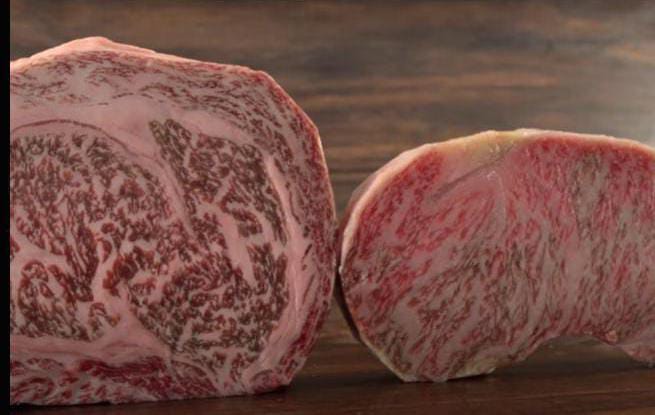
It is the steak that melts at body temperature, tastes like buttered umami silk, and can cost more than a used car.
A single dry-aged piece of Japanese A5 Wagyu has sold for around $3,200.
Regular supermarket ribeye looks like a bargain next to it. So why does aged Wagyu command prices that make even luxury diners blink?
The answer begins with genetics. Authentic Japanese Wagyu comes from four native breeds, overwhelmingly Japanese Black (Kuroge Washu).
These cattle were refined over generations for one trait: extreme intramuscular fat, or marbling.
A5 is the top Japanese grade; only a small percentage of cattle ever reach it.
“The price of wagyu comes down to genetics, time, and precision,” says Golan Haiem, founder of Destination Wagyu.
Time is the second multiplier. Ordinary cattle go to slaughter at 15–24 months.
Wagyu animals are typically raised 28–36 months, often close to three years.
“Their diet is highly controlled, often grain-finished for over 400 days,” Haiem explains.
That long, high-energy diet of grains, rice straw and carefully selected forage produces the snowflake-like fat that gives Wagyu its rich, buttery texture and clean finish.
Extra months mean extra feed, extra labor, extra risk and a delayed payday for farmers.
Japan’s limited land and high labor costs keep production small-scale.
Cattle live low-stress lives, spacious housing, constant monitoring, no growth hormones.
Each animal is traced with a unique ID that records lineage back three generations.
Japan banned live-animal exports decades ago to protect the bloodlines.
The result is genuine scarcity: only a sliver of production ever leaves the country, and every kilogram that does carries certification, cold-chain and tariff costs.
“Importing real Japanese wagyu adds even more cost because of limited supply, certifications, and shipping requirements,” Haiem notes.
Global demand keeps rising. Supply cannot.
Then comes aging. Dry-aging Wagyu takes an already costly product and makes it rarer still.
Over 21–45 days (sometimes far longer) in a controlled chamber, moisture evaporates 10–20 percent weight loss is common, while enzymes tenderize the meat and concentrate flavor into nutty, funky, almost cheese-like notes.
The dried outer crust must be trimmed away, cutting yield again.
Facilities, energy and expertise add more cost.
One well-known YouTube butcher dry-aged an A5 Wagyu picanha and later remarked that the piece was now worth $3,000.
“The results are now the ones you could expect,” he said.
The most famous example of the price ceiling is Matsusaka Wagyu.
In 2002 one cow sold at auction for roughly $400,000.
Its fat melts at an astonishingly low 12°C.
That is the extreme end of a spectrum that already starts at $120–$300 per pound for A5 steaks in the United States.
Is it worth it? Haiem is blunt: “If you’re looking for something unique and high quality, yes. It justifies the price.”
Chefs often serve it in small portions precisely because the richness is overwhelming in large bites.
The fat is higher in monounsaturated fats than ordinary beef, the texture is unlike anything else, and the flavor lingers.
For most people it remains a once-in-a-lifetime indulgence.
For those who can afford it, aged Wagyu is not just dinner.
It is the most expensive, most pampered, most precisely engineered piece of meat on Earth.
The signature snowflake marbling of A5 Wagyu — the visual reason the price soars.
Fresh versus dry-aged Wagyu: moisture loss and flavor concentration come at a steep yield cost.
Inside a Japanese Wagyu barn — small-scale, high-care production that cannot be rushed.

