


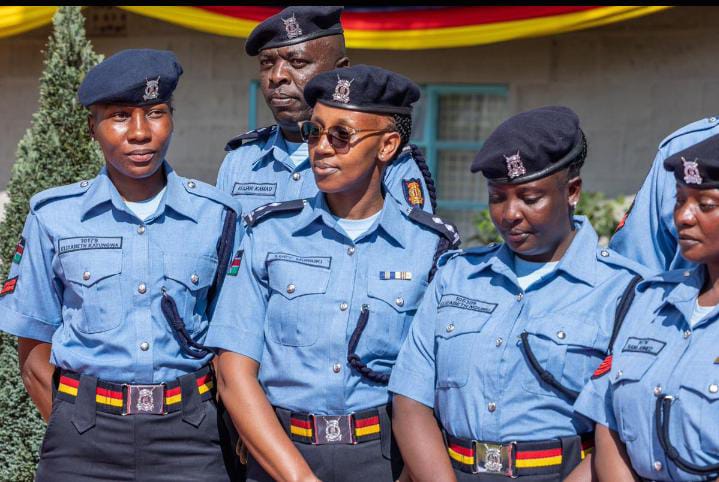
The Sh2.8 billion police uniform controversy has taken a fresh turn after the National Police Service (NPS) named Bedi Investments Limited as the manufacturer, while defending the change of attire as part of reforms linked to the task force chaired by former Chief Justice David Maraga.
The clarification came on Sunday August 30,2026 after reports linked Nalitex Limited to the procurement of the new Kenya Police Service General Duty uniforms, raising questions about the company’s involvement in a multi-billion-shilling government contract.
But the NPS strongly rejected the claims, saying Nalitex was never involved in the procurement process.
“The NPS is particularly concerned that the media reports have introduced an entity referred to as Nalitex Limited into the procurement and manufacture of the new police uniform, yet the said entity does not feature anywhere in the NPS process relating to its development, selection, procurement or manufacture,” the Service said in a statement.
It added: “This association is false and malicious.”
The police service said Bedi Investments was lawfully awarded the contract after a process that involved local textile manufacturers, development of uniform standards, submission and evaluation of samples and public participation.
“For clarity, the new police uniforms are being manufactured by M/s Bedi Investments Limited, which was lawfully awarded the contract by the National Police Service,” NPS said.
According to the Service, four Kenyan manufacturers, Bedi Investments, Rivatex East Africa, Thika Textile Mills and Sunflag Textiles & Knitwear Mills, were invited to submit samples under the Government’s Buy Kenya, Build Kenya initiative.
Only Bedi Investments and Rivatex submitted samples within the stipulated period, with Bedi’s sample eventually selected following evaluation and public participation and approved through the relevant security structures.
The subsequent procurement was conducted under the Public Procurement and Asset Disposal Act, 2015, and applicable regulations.
The controversy has nevertheless placed a spotlight on the justification for the new uniforms and the role attributed to the Maraga task force.
The NPS said the decision to change the General Duty uniform preceded procurement and arose from broader police reforms.
Officers and members of the public had raised concerns about the previous uniform, prompting the Maraga-led team to recommend reverting to earlier uniform colours as part of a wider process of developing a new design.
President William Ruto, who unveiled the new uniforms at the National Police College in Kiganjo on Friday, also described the attire as a product of consultations contained in the police reform process.
“The graduating officers will be the first to wear the new uniform,” Ruto said, announcing that it would subsequently be rolled out progressively to General Duty officers.
But there is a crucial legal wrinkle to the Government’s invocation of the Maraga task force.
The High Court did not declare the entire Maraga task force unconstitutional, contrary to a possible reading of the ruling.
In Benjamin v Attorney General & six others; Maraga & 23 others (Interested Parties), Justice Bahati Mwamuye in April 2025 found that some of the task force’s terms of reference encroached on the constitutional mandate of the National Police Service Commission.
The court specifically held that terms dealing with reviewing and recommending improvements to police terms and conditions of service, welfare and related matters fell within the NPSC’s mandate.
It declared the decision establishing the task force unconstitutional only to the extent that it conferred those specific functions on the task force, and further declared that recommendations resulting from those three terms of reference were unconstitutional, null and void.
The ruling therefore did not wipe out every recommendation made by the Maraga team.
Indeed, the task force had broader terms of reference concerning legal, policy, administrative, institutional and operational reforms, areas the court recognised were not necessarily confined to the NPSC’s constitutional mandate.
On uniforms specifically, the Maraga team had recommended the establishment of a National Uniforms Committee to approve standards, colours and quality of uniforms for disciplined and security services.
It also recommended that the NPS revert to its former uniform colours while work began on a new design.
This distinction now sits at the heart of the unfolding uniform saga: while the NPS is relying on the broader police reform process to explain why the new attire was introduced, the court ruling places constitutional limits on which Maraga task force recommendations can lawfully be relied upon.
For the NPS, however, the procurement itself remains above board.
The Service said it welcomes scrutiny of public procurement but insisted that such scrutiny must be based on accurate and verifiable information.
As officers begin wearing the new light-blue shirts and dark navy trousers from tomorrow, the uniform debate is therefore shifting from the question of who made it to the bigger questions of how the contract was awarded, how much taxpayers will ultimately pay and which recommendations of the Maraga reforms remain legally enforceable.

