


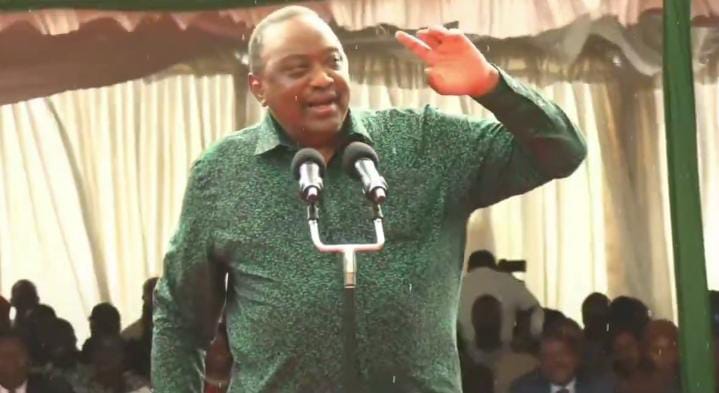
Former President Uhuru Kenyatta has rejected claims he is sponsoring opposition leaders, insisting Kenyans alone will decide their preferred leaders in the 2027 elections.
Uhuru spoke on Sunday in Kitale, Trans Nzoia County, where he joined family members, political leaders and residents in marking the 23rd anniversary of the death of former Vice President Michael Kijana Wamalwa.
The former President arrived at Wamalwa’s Milimani home to a warm reception, with supporters breaking into song and dance as he was welcomed to the memorial.
He was received by Wamalwa’s brother and DAP-Kenya leader Eugene Wamalwa, alongside Wiper leader Kalonzo Musyoka, People’s Liberation Party leader Martha Karua, former Interior Cabinet Secretary Fred Matiang’i, former Kitui Governor Charity Ngilu and Democratic Party leader Justin Muturi.
Uhuru later proceeded to Wamalwa’s mausoleum, where he laid a wreath and paid tribute to the former Vice President.
He also launched a book titled “My Country First ” documenting Wamalwa’s life and political legacy, for which he wrote the foreword.
Eugene Wamalwa said the publication had taken 23 years to complete.
But it was Uhuru’s remarks on the country’s political landscape that drew the greatest attention during the memorial.
The retired President sought to distance himself from claims that he was backing particular opposition politicians as political realignments gather pace ahead of the 2027 elections.
He said Kenyans should be allowed to freely choose their preferred leaders without interference from political figures.
“It’s the people who will decide. If they say it is Kalonzo, Ruto, Matiang’i, or Sifuna, it will be so. I don’t want to be called a sponsor; I have just said the power belongs to the people,” Uhuru said.
The crowd cheered when Nairobi Senator Edwin Sifuna was mentioned, prompting Uhuru to make a pointed response.
“Jameni chungeni, sitaki kuitwa sponsor,” he said.
Uhuru insisted that his presence at political gatherings or his interaction with opposition leaders should not be interpreted as an indication that he intends to return to active politics.
“People should not say that I am engaging in politics. I don’t have any interest in any seat,” he said.
The former President, who served as Kenya’s Head of State from 2013 to 2022, also reflected on his own political journey, urging politicians seeking elective positions to approach voters with humility.
“If you want votes, ask Kenyans politely; they will give them to you or deny you. I asked them at first and I was denied, I came back again and they voted for me,” Uhuru said.
“I thank God for the years he has given me in leadership. I thank Kenyans for giving me that chance.”
He also challenged political leaders to allow their opponents to campaign freely, warning against attempts to prevent rival groups from holding public meetings.
“I want to ask political leaders to talk to the people peacefully. This thing of stopping rivals from holding meetings should stop,” Uhuru said.
“Kenyans should not be forced to join this faction or that one. Kenyans should choose by themselves.”
His remarks came against the backdrop of growing political activity as parties and prominent leaders position themselves for the 2027 presidential contest.
Uhuru, however, maintained that political leaders should not dictate the choices of voters, saying Kenyans must be allowed to determine their preferred candidates.
He linked his call for political tolerance to Wamalwa’s legacy, describing the late Vice President as a key figure in Kenya’s democratic struggle.
Uhuru described Wamalwa as one of the better angels of our nature and the gentleman of Kenya’s politics.
“We are a democratic society, and those democratic ideals were fought for very hard… And we cannot allow ourselves to go backward,” he said.
Wamalwa served as Kenya’s eighth Vice President under retired President Mwai Kibaki after the National Rainbow Coalition won the 2002 General Election.
He died in London on August 23, 2003, aged 59, after a long illness.
The annual memorial has continued to bring together political leaders from across the country to celebrate his contribution to Kenya’s democratic struggle and political history.
This year’s event brought together Uhuru, Kalonzo, Karua, Matiang’i, Eugene Wamalwa and other leaders, providing a significant political gathering as the country moves closer to the 2027 elections.
Despite the political significance of the gathering, Uhuru maintained that he was not seeking any political seat and that the ultimate decision on Kenya’s next leaders belongs to the electorate.

