


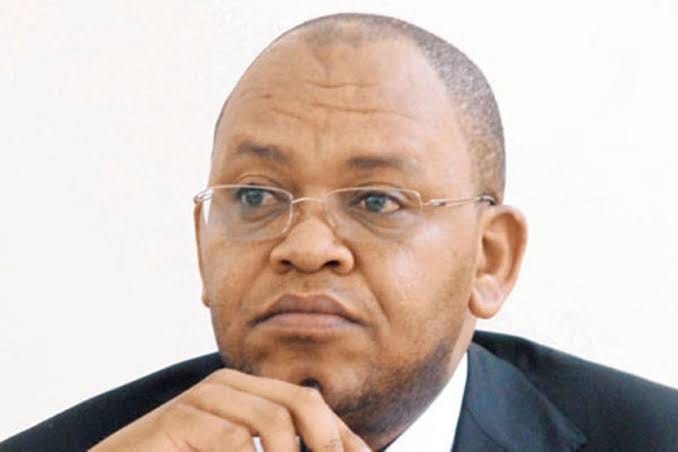
The death of former High Court Judge Joseph Mbalu Mutava has brought to an abrupt end the life of a lawyer whose career was marked by judicial ambition, controversy, courtroom battles and a dramatic return to the headlines.
Mutava, the husband of Kibwezi East MP Jessica Mbalu, died at about 4am on Saturday while being rushed to Makindu Hospital in Makueni County, his family has confirmed.
According to the family, Mutava was in good spirits on Friday and attended the burial ceremony of a close family friend.
By the following morning, the former judge was dead.
For a man who spent years in the corridors of power and justice, Mutava’s final chapter was as dramatic as much of his legal career.
He had served on the High Court bench before becoming one of the few judges in Kenya’s post-2010 constitutional era to be subjected to a tribunal under Article 168 of the Constitution and ultimately removed from office.
Years later, after returning to private legal practice, he again found himself in the sights of anti-corruption investigators.
His name resurfaced in March 2026 when the Ethics and Anti-Corruption Commission arrested him over allegations surrounding an alleged Sh10.4 million attempt to influence the outcome of a commercial dispute involving former Cabinet minister Raphael Tuju.
Interesting, his death comes days after the DPP on July 20,2026 ordered the EACC to close investigations against him into the bribery allegations in Tuju’s case.
Mutava was appointed a Judge of the High Court on August 23, 2011.
His tenure on the bench, however, was short-lived.
Between March 2012 and March 2013, the Judicial Service Commission received 13 complaints concerning his conduct.
The complaints related to several cases that he had handled or was alleged to have influenced.
The complaints eventually triggered one of the most closely watched judicial disciplinary processes under the 2010 Constitution.
The JSC investigated the complaints and concluded that some met the threshold for further action.
On May 20, 2013, it petitioned the then President Uhuru Kenyatta to suspend Mutava and appoint a tribunal to investigate his conduct.
The tribunal was eventually constituted under Article 168 of the Constitution.
At the centre of the proceedings was a controversial case involving businessman Kamlesh Mansukhlal Damji Pattni.
Mutava was accused of causing Nairobi High Court Miscellaneous Judicial Review Application No. 305 of 2012 involving Pattni to be allocated to him irregularly and without the knowledge or consent of the duty judge and the head of the Judicial Review Division.
He was further accused of retrieving the file from the Judicial Review Division and taking it to the High Court in Kericho.
Another allegation was that he proceeded to write a judgment in the Pattni case while the JSC was investigating complaints against him relating to the same matter.
The tribunal also examined allegations concerning another commercial dispute, Sehit Investments Ltd against Josephine Akoth Onyango and three others.
Mutava was accused of soliciting Sh2.5 million on behalf of retired Justice Leonard Njagi and of attempting to influence the judge through telephone calls and text messages.
These were serious allegations, and the tribunal’s proceedings placed the conduct of a serving High Court judge under unprecedented scrutiny.
In its report dated September 20, 2016, the tribunal found that three of the allegations against Mutava had been proved to the required standard and concluded that his conduct amounted to gross misconduct contrary to Article 168(1)(e) of the Constitution.
It recommended his removal from office.
Mutava did not accept the decision.
Instead, he embarked on a legal battle that eventually reached the country’s highest court.
The Supreme Court case became significant in its own right because it gave the apex court an opportunity to define the scope of its appellate jurisdiction over tribunals established to investigate judges.
In March 2019, the Supreme Court dismissed Mutava’s appeal and affirmed the tribunal’s findings and recommendation for his removal.
The five-judge bench comprised then Deputy Chief Justice Philomena Mwilu, Justices Mohamed Ibrahim, Jackton Ojwang, Njoki Ndungu and Isaac Lenaola.
The court held that the tribunal had established two of the allegations against Mutava to the required standard.
The Supreme Court specifically affirmed the finding that his conduct amounted to gross misconduct under Article 168(1)(e) and upheld the tribunal’s recommendation that he be removed from office.
The decision was historic.
The Supreme Court itself later described the case as the first time it exercised its jurisdiction under Article 168(8) to determine an appeal arising from a tribunal appointed to investigate the conduct of a judge.
The court said it had a duty to re-evaluate and reassess the evidence before determining whether the tribunal had misdirected itself.
The decision therefore became an important reference point in discussions about judicial accountability and the removal of judges.
For Mutava personally, however, it marked the end of his career on the High Court bench.
One of the most enduring chapters of Mutava’s judicial career was his involvement in the Pattni matter.
The case involved Kamlesh Pattni, the businessman associated with the Goldenberg scandal, one of Kenya’s biggest financial scandals.
The tribunal’s concern was not simply the outcome of the case but the circumstances surrounding its allocation and Mutava’s handling of it.
The Supreme Court subsequently affirmed the finding concerning the irregular allocation of the case and other misconduct allegations.
The case would remain attached to Mutava’s public record long after he left the bench.
The controversy also touched his family.
Jessica Mbalu, who was then Mutava’s wife and is now the Kibwezi East MP, testified before the tribunal during the proceedings.
Her evidence became part of the broader examination of the allegations against her husband.
The proceedings attracted considerable public attention because of the unusual circumstances of a sitting judge facing allegations involving people connected to cases before the courts, while his spouse was also a public figure.
The tribunal ultimately proceeded to make its findings against Mutava.
Removal from the Judiciary did not end Mutava’s legal career.
He continued practising law as an advocate, remaining active in legal circles.
But the controversies surrounding him did not entirely disappear.
In March 2026, almost a decade after the tribunal proceedings, Mutava was again thrust into the national spotlight after his arrest by EACC detectives.
This time, the matter involved Tuju and a commercial dispute before the High Court.
On March 9, 2026, EACC detectives arrested Mutava alongside advocate Kimani Wachira and two other suspects over allegations of soliciting a Sh10.4 million bribe to influence the outcome of a commercial dispute involving Tuju.
The suspects were held at the EACC Integrity Centre and were later released on Sh200,000 police cash bail each.
The commission was expected to forward the investigation file to the Director of Public Prosecutions for consideration who later returned the file with instruction of closure with no further action.
The alleged scheme centred on a dispute involving Tuju’s properties and a High Court case.
Mutava’s arrest came on the same day Justice Josephine Mongare delivered a ruling in the commercial dispute.
Another lawyer arrested in connection with the investigation later challenged the manner in which the case had been handled, denying involvement in bribery and arguing that the events had been misconstrued.
That dispute remained unresolved when Mutava died.
But beyond the cases and controversies, Mutava was also a husband, father, colleague, lawyer and member of a family.
His sudden death at about 4am on Saturday has now closed that chapter.
The circumstances surrounding his final hours remain known only to his family and the medical professionals who attempted to save him.
What is already clear is that Joseph Mbalu Mutava leaves behind a legal legacy that will continue to be debated,not only because of the controversies that defined his judicial career, but also because of the constitutional precedents arising from the battle that followed his removal.
For Kenya’s legal fraternity, his death marks the passing of a former judge whose name became woven into some of the country’s most consequential debates about judicial conduct, accountability and the limits of judicial power.
And for the Mbalu family, the legal battles and public controversies are now secondary to a much more immediate reality: the sudden loss of a husband and family man who, according to his relatives, was alive and full of life only hours before his death.

