


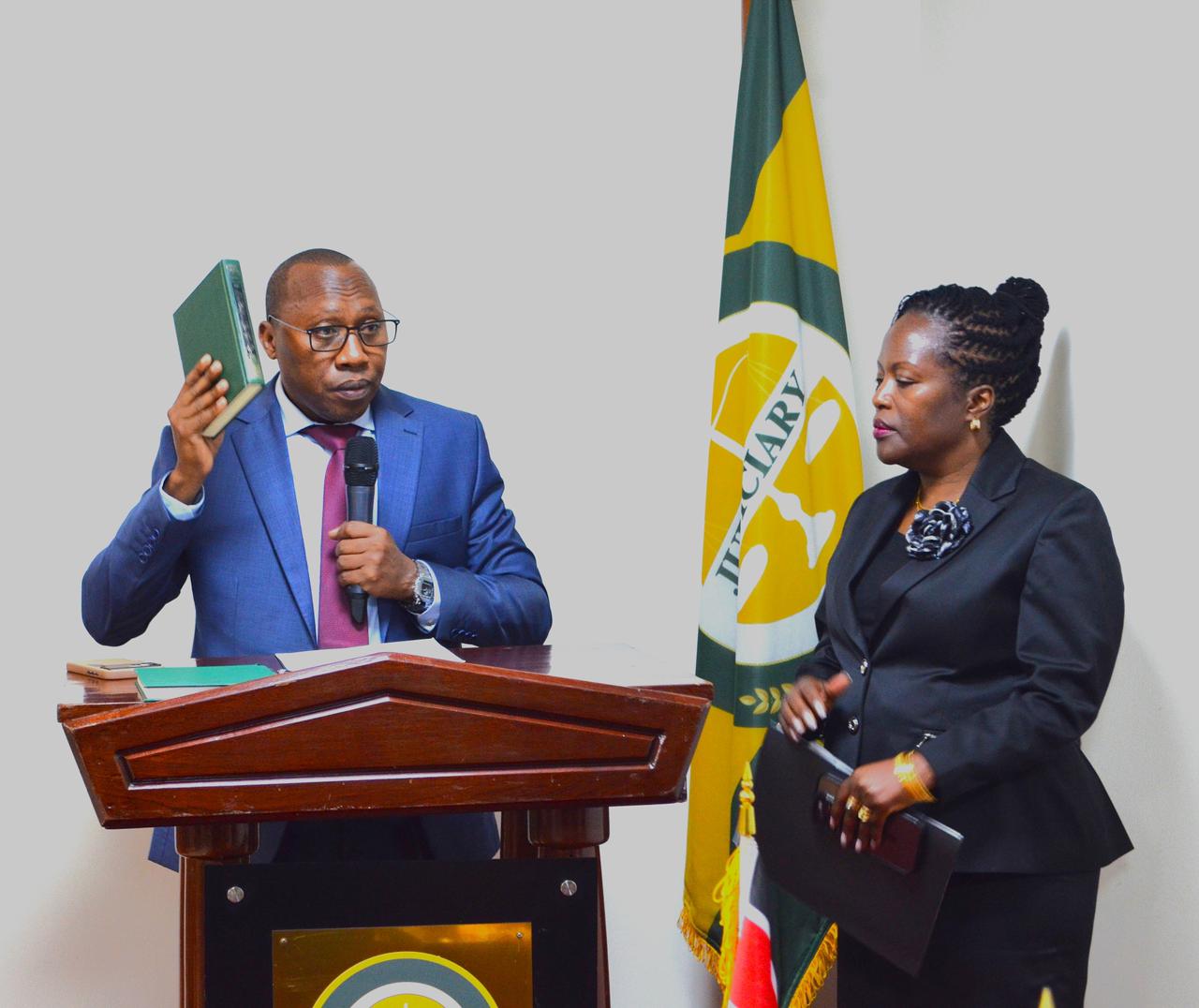
In a significant development for Kenya’s public sector governance, Chief Justice Martha Koome has administered the oath of office to Mr. Ali Abdullahi Surraw, marking his official entry as the Commission Secretary and Chief Executive Officer of the Salaries and Remuneration Commission.
The ceremony, held at a function attended by senior government officials and members of the commission, signaled a new chapter for the constitutional body responsible for managing public sector wages and benefits across the country.
Mr. Surraw takes over from Dr. Anne Gitau, whose tenure as CEO spanned from 2015 to June 2025, a period that saw the commission navigate complex challenges in balancing fair compensation for public servants with fiscal sustainability.
His appointment received approval from the National Assembly in December 2025 after successful vetting by the Labour Committee, culminating a competitive recruitment process that began with the shortlisting of seven candidates in August last year.
Speaking at the event, Chief Justice Koome emphasized the weight of responsibility now resting on Mr. Surraw’s shoulders, noting that he must work alongside the commission’s leadership to ensure the onerous responsibility of ensuring that the Commission continues to discharge its constitutional mandate of promoting equitable, transparent, and sustainable management of public sector remuneration.
The Chief Justice outlined one of the central challenges facing the new CEO: striking “a careful balance between the legitimate expectations of state and public officers for fair and equitable remuneration, and the constitutional imperative of fiscal responsibility and sustainability.”
She warned that this balance is essential to the long-term stability of public institutions and the entire national economy.
In her remarks that highlighted inter-institutional cooperation, Chief Justice Koome praised the existing partnership between the Judiciary and the SRC, calling it close and constructive and noting its importance in attracting, retaining, and motivating highly skilled professionals within the Judicial Service.
The new CEO assumes office at a time when the SRC faces heightened public scrutiny over the management of Kenya’s public wage bill and the sustainability of compensation structures, challenges that will test his leadership from the outset.
The swearing-in ceremony coincided with another major judicial recruitment exercise.
Chief Justice Koome revealed that the Judicial Service Commission had begun conducting interviews for prospective Court of Appeal judges, with similar processes planned for High Court judges, Environment and Land Court judges, and Kadhis.
The Chief Justice disclosed that the commission recently appointed 100 Resident Magistrates on December 11, 2025, describing the move as a critical intervention aimed at reinforcing the Magistracy, which remains the primary entry point to justice for most Kenyans.
She characterized the comprehensive judicial recruitment drive as a coherent, system-wide approach to enhancing judicial capacity, reducing case backlog, and ensuring that justice is not only done, but done in a timely and effective manner.
In her concluding remarks to Mr. Surraw, Chief Justice Koome reminded him that his oath must serve as your constant guide in the discharge of your duties.
“It binds you to unwavering fidelity to the Constitution and the law, and calls upon you to serve this country with diligence, integrity, and devotion, mindful of the immense responsibilities entrusted to you,” she stated.
The Chief Justice assured the new CEO of the Judiciary’s continued commitment to collaboration in advancing constitutional governance and service to the people of Kenya.
The Salaries and Remuneration Commission, established under the 2010 Constitution, plays a crucial role in determining and reviewing the salaries and benefits of all state officers and public servants in Kenya, making it one of the most influential independent commissions in the country’s governance structure.

