


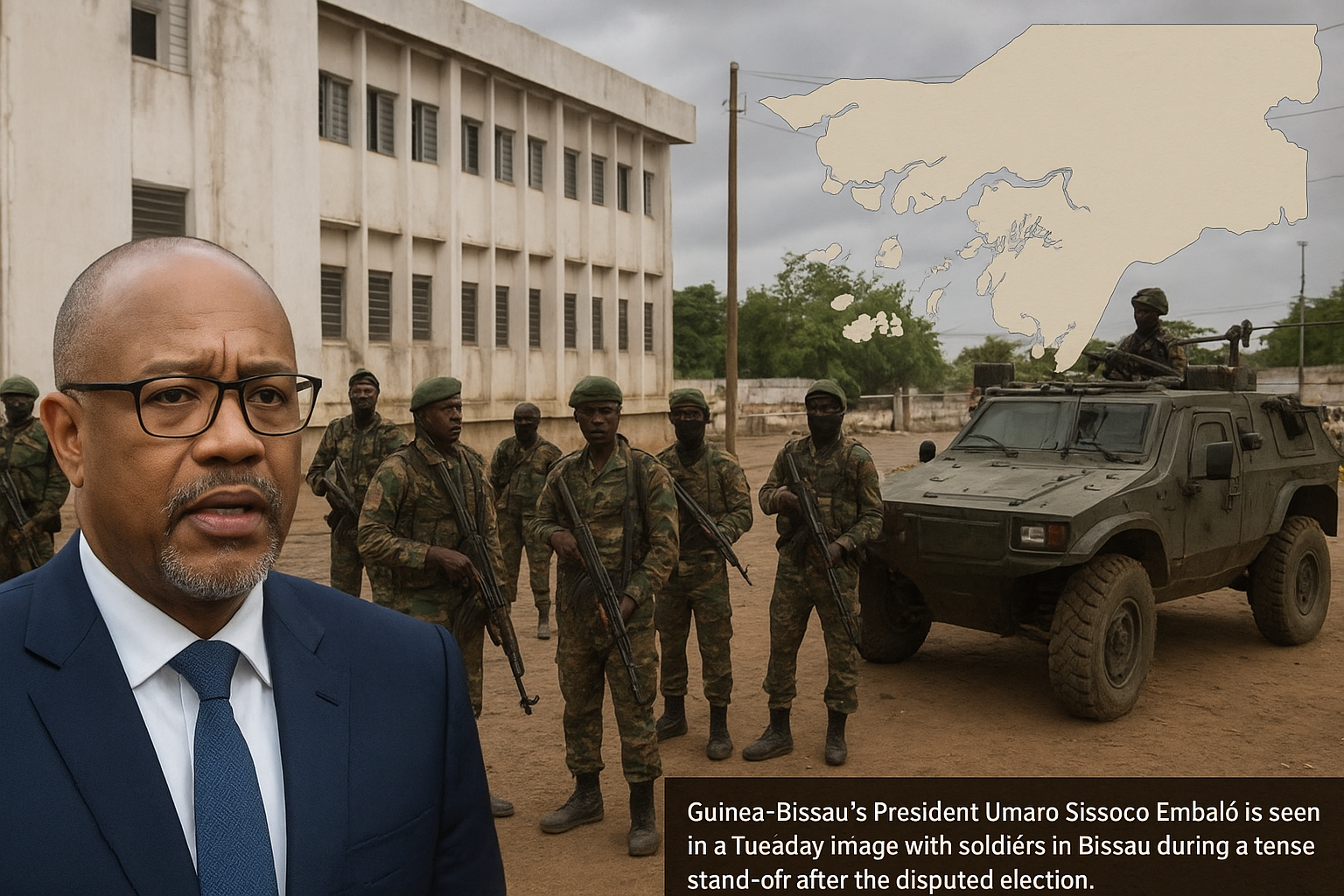
Heavy gunfire erupted across the capital Wednesday as armed soldiers stormed the presidential palace, prompting reports that President Umaro Sissoco Embaló has been detained, a dramatic turn in a crisis triggered by disputed elections and rival claims to power.
In a televised statement shortly after midday, a contingent of military officers announced they had assumed “total control” of the country and formed what they called the High Military Command for the Restoration of Order, suspending all state institutions, sealing the borders, and suspending the electoral process.
“We have taken control as all branches of the armed forces,” declared Brigadier‑General Denis N’Canha at a press conference, flanked by armed soldiers.
President Embaló, in interviews given after his detention, called the events “a coup d’état.”
He said he was arrested at around 13:00 GMT in his office at the presidential palace, along with top military and interior ministry officials.
The crisis comes just days after a tense presidential and legislative election held on Sunday 23 November.
Both Embaló and opposition challenger Fernando Dias da Costa, whose candidacy came after the historic party PAIGC was disqualified — claimed victory before any official results were released.
Gunfire rang out near the offices of the national electoral commission, the presidential palace, and the interior ministry, sending residents fleeing and prompting fears of large‑scale violence.
A spokesperson for Embaló accused “unknown gunmen” linked to Dias of attempting to sabotage the result announcement by attacking the electoral commission, a claim Dias’s camp has denied.
Guinea‑Bissau has endured repeated coups since independence in 1974; the events of Wednesday mark the most dramatic political shift in recent years.
The seizure of power and suspension of the election process threaten to upend what little democratic stability the country has enjoyed. The current crisis raises fundamental questions about electoral legitimacy, military influence, and the rule of law.
International observers had described the election as largely calm and orderly, with over 960,000 voters participating.
Yet the sudden collapse into chaos underscores deep divisions within the political and security establishment.
For many in Guinea‑Bissau, the coup is not simply a change of guard: it is a blow to the hope that elections offered for peaceful transitions of power and governance.
The military leadership says institutions remain suspended “until further notice,” raising the spectre of prolonged military rule. Borders have been closed, a curfew imposed, and all media broadcasts suspended.
As of now, neither official results from the election nor a credible transition timetable has been announced ,leaving ordinary citizens uncertain about their future.
Regional bodies, including ECOWAS, and international partners are expected to respond soon.
Their reaction could shape the country’s political trajectory,whether toward a return to democratic order or deeper instability.
Meanwhile, peace‑loving citizens and civil society groups are calling for calm, restraint, and negotiations to resolve the impasse without further violence.
One witness, speaking from the outskirts of the presidential palace, described the moment when soldiers sealed off roads and opened fire.
“There were masked men everywhere. We heard loud gunshots, then the soldiers blocked all exits. People fled in panic,” he said, asking not to be named for fear of reprisals.
“We voted just days ago hoping for change. Now the country feels like it is going backwards, we don’t know who will lead us.”
This dramatic turn of events in Guinea‑Bissau is a reminder that in fragile democracies, an election is only as credible as the institutions that uphold its outcome.
When the military intervenes, it doesn’t just seize power, it undermines trust, resets the clock on governance, and plunges ordinary lives into uncertainty.
As the world watches, Guinea‑Bissau stands at a crossroads.
The choices made in the next days, by military leaders, politicians, civil society, and international stakeholders, will determine whether the country heads toward renewed instability or seizes a chance to rebuild democratic order from the ashes.

