


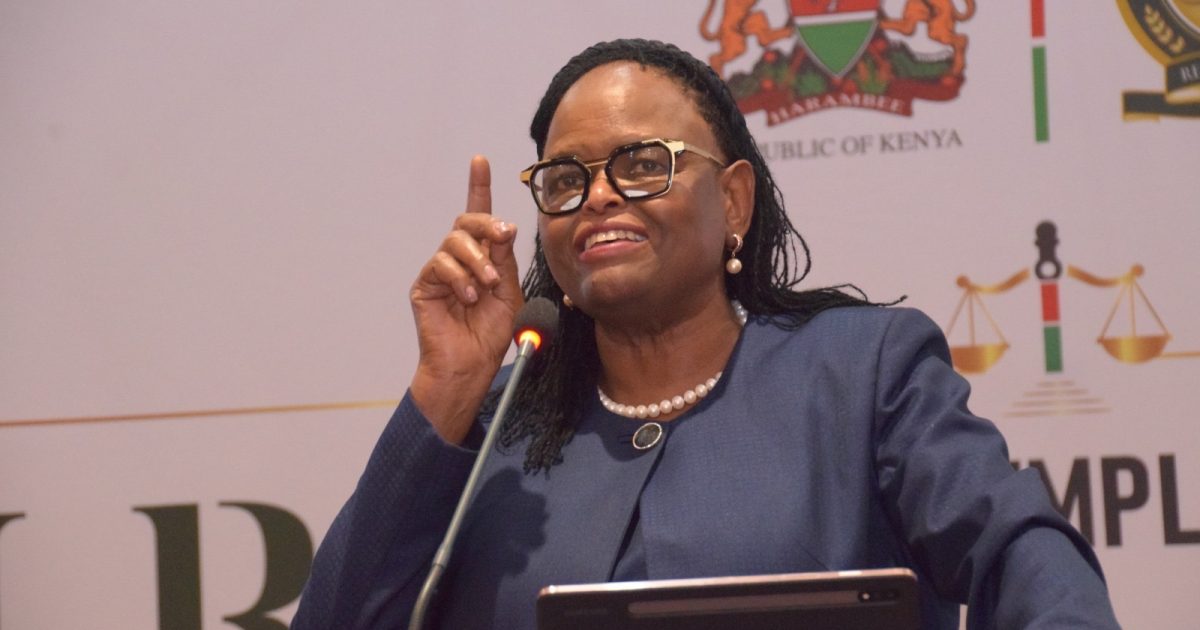
Chief Justice Martha Koome has hailed the Constitution of Kenya, 2010 as a transformative charter that has revolutionized the country’s governance, justice delivery, and institutional accountability.
Speaking at a Katiba Day forum marking the 15th anniversary of the Constitution’s promulgation on Wednesday, August 27, 2025, CJ Koome described the charter as a “catalyst for social justice, equality, and rule of law.”
The event, hosted by the Nation Media Group under the theme “Fifteen Years Later: The Constitution and Us”, brought together legal minds, civil society leaders, and public officials to reflect on the impact and evolution of Kenya’s constitutional journey since 2010.
“Fifteen years later, we can look back with pride at the distance we have travelled,” CJ Koome said.
“The Judiciary has undergone profound reform, developed transformative jurisprudence, and expanded access to justice for all—though persistent challenges remain.”
Tracing the Judiciary’s reform journey over the past decade and a half, CJ Koome outlined three major strategies that have guided institutional change: the Judiciary Transformation Framework (JTF) under former CJ Willy Mutunga, Sustaining Judiciary Transformation (SJT) under retired CJ David Maraga, and the ongoing Social Transformation through Access to Justice (STAJ) strategy that will guide reforms through 2033.
“The greatest outcome of these reforms has been the strengthening of judicial independence,” she said.
“Kenyan courts have demonstrated courage in asserting themselves as defenders of constitutionalism, earning respect across Africa and beyond.”
She cited landmark cases that have defined Kenya’s evolving jurisprudence, including the Supreme Court’s rejection of the BBI constitutional amendment, decisions affirming housing rights in Mitu-Bell and Musembi, the historic Muruatetu ruling abolishing the mandatory death sentence, and the court’s 2023 affirmation of LGBTQ+ persons’ freedom of association.
CJ Koome also emphasized the role of technology in revolutionizing court services.
Since launching the e-filing system in Nairobi in 2020, and scaling it nationwide by 2024, the Judiciary has moved much of its operations online, including virtual hearings, e-payment of court fees, and cause-list tracking through real-time dashboards.
“Litigants can now access justice online, pay fees electronically, and even attend hearings virtually,” she explained.
“These digital innovations have transformed the delivery of judicial services.”
The Judiciary has also extended its physical presence, with High Court stations now operational in all 47 counties, improving access to justice even in historically underserved regions.
Despite notable strides, CJ Koome admitted the Judiciary still faces serious challenges, among them budgetary constraints, case backlogs, and new forms of intimidation such as cyberbullying and targeted misinformation campaigns.
“Criticism of court decisions must follow lawful channels, not digital harassment,” she cautioned, noting that the Judicial Service Commission (JSC) has processed over 946 complaints against judicial officers since 2010 as part of its internal accountability mechanisms.
She further lamented the Judiciary’s minimal budget allocation, which remains below 1% of the national budget, calling it inadequate for an institution with a mandate as critical as health or education.
“Justice cannot flourish without sufficient resources. The Judiciary deserves stronger financial support to deliver on its constitutional obligations,” Koome asserted.
Also speaking at the event, Chief Registrar of the Judiciary Winfridah Mokaya reiterated the Judiciary’s responsibility in ensuring constitutional fidelity across all arms of government.
“It has been the Judiciary’s role to fiercely and constantly patrol the boundaries of the Constitution, ensuring no individual or institution operates beyond them,” Mokaya said.
“In doing so, we help realize the dreams and aspirations of the Kenyan people.”
In her closing remarks, Chief Justice Koome reaffirmed the Judiciary’s commitment to the Kenyan people and the ideals enshrined in the 2010 Constitution.
“We will continue to administer justice without fear or favour, check abuses of power, and defend the rights of all Kenyans,” she said.
The Katiba Day forum served not only as a celebration but also as a call to action—to strengthen the gains made under the Constitution, confront lingering injustices, and deepen Kenya’s democratic values through the rule of law.

