


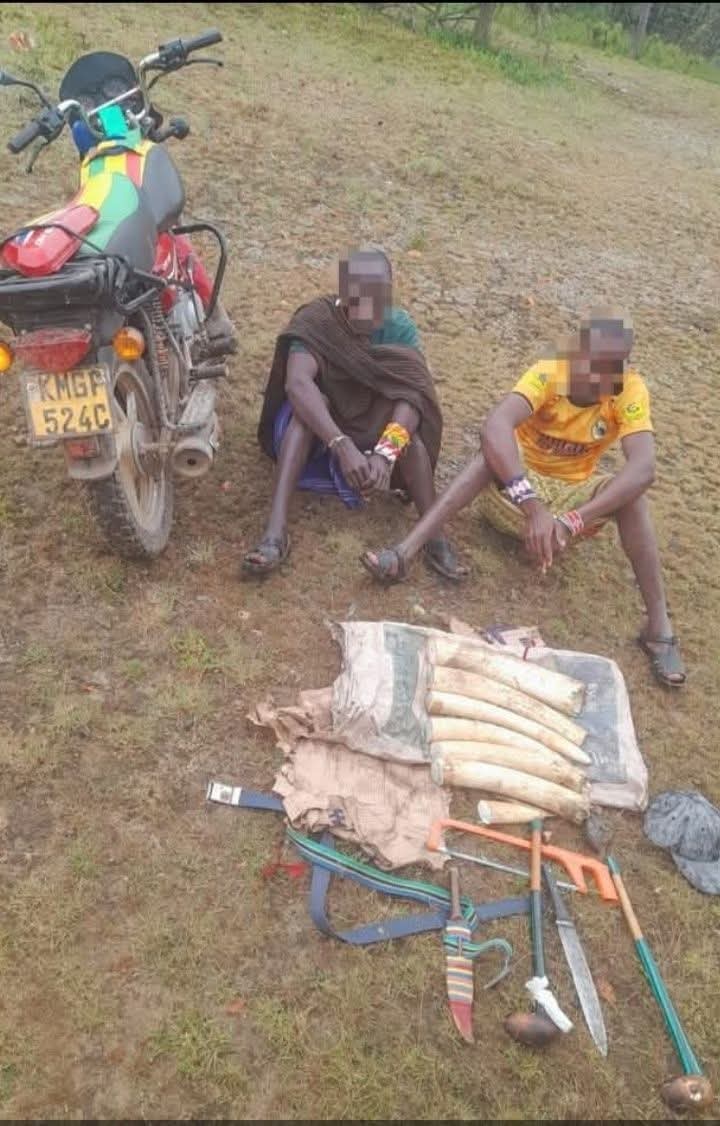
Police in Samburu County have arrested two suspects and recovered seven pieces of elephant tusks weighing approximately 11 kilograms, with an estimated street value of over Sh1.1 million.
Confirming the incident, Samburu Central Police Division Commander John Mwai said the suspects were nabbed following a well-coordinated intelligence-led operation conducted by officers from the Kenya Wildlife Service (KWS) and the National Police Service (NPS).
“Our officers received intelligence that the suspects were in possession of the tusks and were planning to sell them to potential buyers,” said Mwai.
“We laid an ambush and managed to arrest them before the transaction could take place.”
The two suspects were apprehended on Monday evening at Maralal town, where they were allegedly seeking buyers for the illegal wildlife trophies.
According to police reports, the tusks were concealed in a gunny bag and transported using a motorcycle.
“Upon searching the suspects, we recovered seven pieces of elephant tusks weighing 11 kilograms,” Mwai said.
“They could not account for their possession, and investigations are ongoing to establish the source and their intended market.”
He said the suspects are being held at the Maralal Police Station and will be arraigned in court once investigations are complete.
The recovery marks another success in ongoing efforts by security agencies to curb wildlife trafficking in northern Kenya, a region that has long been a hotspot for elephant poaching due to its vast, rugged terrain and proximity to major smuggling routes.
Mwai commended officers for their swift response and warned those involved in the illegal trade that they would be dealt with firmly under Kenya’s wildlife protection laws.
“We are intensifying surveillance and patrols within Samburu and neighbouring counties. Anyone found engaging in wildlife poaching or trafficking will face the full force of the law,” he said.
The Wildlife Conservation and Management Act (2013) prescribes stiff penalties for wildlife-related crimes, including life imprisonment or fines of not less than Sh20 million for those convicted of dealing in elephant ivory.
KWS officials who took part in the operation said the recovery was made possible through close collaboration between the police, community informants, and conservation partners.
“The public has been instrumental in providing actionable intelligence,” said one KWS officer, who requested anonymity.
“We encourage continued cooperation because wildlife crime is not just a conservation issue but also a national security concern.”
Kenya has made significant strides in combating poaching in recent years, with authorities crediting enhanced law enforcement, stiffer penalties, and community awareness campaigns for a reduction in elephant killings.
However, illegal trafficking remains a challenge, especially in regions bordering national reserves such as Samburu National Reserve and Buffalo Springs, where elephants frequently roam outside protected zones.
Mwai urged local residents to continue supporting anti-poaching efforts by sharing information with law enforcement agencies.
“We are appealing to members of the public to remain vigilant and report any suspicious activities related to wildlife products,” he said. “Protecting our wildlife is a collective responsibility.”
The recovered tusks have been handed over to the Kenya Wildlife Service headquarters for safekeeping and further forensic analysis to determine the age and origin of the elephants involved.

